Wednesday, November 08, 2006

Shlomo’s Drash - Vayera 5767 Sodom and Disney


Genesis 18:1-22:4

This week we continue the story of Abraham. Abraham is sitting in the heat of the day in his tent. While being visited by God, he sees some strangers, and runs out to them to show hospitality. After a big meal, they tell him that he and Sarah will have a son within a year, which makes Sarah laugh. When these strangers start back on their way to Sodom, they tell Abraham that they are to destroy Sodom and the other cities of the plain. Abraham has a debate with God if this is a good idea and even bargains down what it will take to save the city. We then cut to Sodom and two angels and their experiences in the town of Sodom, who decide the only one worth saving is Abraham's nephew Lot and his family, who escape, but not without casualties. Abraham then moves into the land of the Philistines, and once again uses the "sister" excuse describing his relationship with Sarah. After this adventure, Sarah conceives and has a son, Isaac, which causes more sibling and maternal rivalry with Hagar and Ishmael. The last major story in this section is, of course, God telling Abraham to go to a mountain and to sacrifice Isaac.


In the middle of the story we have the destruction of Sodom and Gomorrah. But the story has an interesting twist, in giving us a glimpse at the attitudes of the people of Sodom.


4. But before they lay down, the men of the city, the men of Sodom, surrounded the house, from boys to old men, all the people from every quarter; 5. And they called to Lot, and said to him, Where are the men who came in to you this night? Bring them out to us, that we may know them. 6. And Lot went out the door to them, and closed the door after him,7. And said, I beg you, my brothers, do not do so wickedly. 8. Behold now, I have two daughters who have not known man; let me, I beg you, bring them out to you, and do to them as is good in your eyes; only to these men do nothing; seeing that they have come under the shadow of my roof. 9. And they said, Stand back. And they said again, This one fellow came in to sojourn, and he wants to be a judge; now will we deal worse with you than with them. And they pressed hard upon the man, Lot, and came near to break the door. 10. But the men put forth their hand, and pulled Lot into the house to them, and closed the door. 11. And they struck with blindness the men who were at the door of the house, both small and great; so that they wearied themselves to find the door.

It is from this passage that some have interpreted any form of homosexuality as Sodomy. Yet in a good reading of it the issue is the lack of hospitality. It is clear given Lot’s pleas that sexual contact is involved, and he knows they are up to bad things. We also have plenty of evidence that “to Know” is a word for sexuality in Hebrew. Targum Pseudo Jonathan changes the word to the Aramaic N’shameish, a far more explicit name for sex, one which implies subservience of the one receiving sex. In Sodom everyone is involved in sex, and tellingly even young boys want to have sex with the strangers. This is a culture of rape and child abuse so ingrained that all from the youngest age find sex something to subject others to. In reality, Sodomy is not homosexuality, but something truly abhorrent -- rape and abuse as a form of power. The people of Sodom want to use the guests for their own purposes with out any consideration of their needs, with guests subservient to the pleasures of their hosts.


We can compare the Response of the People of Sodom to the presence of strangers to the response of two others. The first of course is Lot himself who urges that the two strangers don’t spend the night in the village square, and then offers them food and lodging. The second is Abraham, who, recovering from his circumcision, runs out of his tent to actually intercept strangers to be his guest, and turns a “small morsel” into a full nine-course meal. The difference is pretty clear -- the host met the needs of the guests first, and in both cases, the Guests end up doing something for the hosts.


Last week, I was in what was billed as “The Happiest Place on Earth” on vacation. I got a lot of well deserved rest, and feel very refreshed coming back to a mountain of things I have to do in the real world. It was the week for my annual pilgrimage to Walt Disney World in Orlando Florida. Waiting 30 minutes in line for Thunder Mountain I reflected on this place and wondered about many things. Checking the numbers later, they tend to be big: there are over 25,000 guest rooms and over 57,000 cast members at the Orlando property alone, making it the biggest single site employer in the United States. A bus driver told me they had a fleet of 400 buses with 1000 bus drivers. Disney resorts worldwide had revenues of 9 billion dollars for 2005. Looking at such numbers, one has to wonder why the world would spend so much money on such a place.


Of course, the talking candelabra from Beauty and the Beast, Lumiere, has the answer; “Be our guest!” Indeed Disney customer service is the reason I and a lot of other people, keep going back to do the same vacation time and time again. They know they are going to be treated well. As a single traveler, Disney is the only destination I have ever gone where I never felt like a pariah, ignored by servers and staff. Even in my home town, I have had that experience. But never, ever Disney. So every year, when I want to get away by myself and relax, I go to Orlando, knowing I will get treated as royally as Prince Charming.


Anybody can give you food, anybody can give you shelter. It’s how they give the service that makes a difference, that produces a wow! The rabbis note that Lot is not as credited with hospitality as much as Abraham is. Abraham and Sarah took time to make a whole feast, including bread and cake from the best flour, butter, meat etc. Lot served Matzah. But Abraham did not just make it, but made it all in front of his guests as a show, as a story. Lot never mentions cooking, and thus probably took a stale box of Matzah out of the cupboard. I think Abraham’s actions point to one more thing that makes hospitality work, and makes it holy and special. It is to tell a story.


In Disney, story is everywhere. I once took a course on Disney Imagineering, taught on property with plenty of backstage access. Before anything in a guest area is built, a story is written first. For example, for a new attraction at Animal Kingdom, a story was written about an express route train to the Base of Mount Everest where you can begin a trek up the mountain. However, this goes through the range of the protector of the mountain the Yeti, who may not be happy to see trespassers. When you get on the ride you find out how unhappy - the Yeti has torn up the tracks and throws you back and forth in your train car across the mountain range, through dark tunnels and down the steep ridge of a mountain, all the while roaring at you and taking swipes at you.


Had I said that they put in a rollercoaster in Animal Kingdom, that statement would not have gotten the same reaction as the Story of Expedition Everest. In my attempt to get over my fear of roller coasters, I did actually ride this one. It was not until I got on line did I find out that it was one of the most intense rides in the park, something I figured out while partially panicking in my first corkscrew (in the dark no less) on a roller coaster. But the ride started far before I got on line. The story of the ride started when I took a fork in the path from the Thai temples of Kali river rapids and the buildings around me were now disguised as climbers supply stores. The story followed in the dress of the cast members, the train station we lined up in to get into our railroad cars and the sacred shrines to the Yeti, complete with offerings. It continues as our cars climbed up the mountain, through a temple dedicated to the Yeti. The story was not just one robotic abominable snowman - it was everywhere. This is what separates Disney from a mere amusement park.


One other part of hospitality, I believe, is story. Abraham created story with his food preparation while his guests rested. This is the story found today in many a display kitchen, where you can watch the cooks make your food, a Mongolian barbecue or ultimately a teppanaki grill, where the grill itself is your table. The fun and story is watching the cook make your food. I stayed at the Budget-rate Pop Century resort on property. As I could tell from the abandoned second half of the project, this really was nothing more than a motel room at any generic rest stop in America. Yet Disney’s story at Pop Century resort was the popular culture of 1950-1990. Staying in my seventies-themed hotel room with a three story Big Wheel and Mickey Mouse phone in front of the elevators, the wallpaper with disco themes, to the 1990’s pool shaped like a laptop the ordinary became extraordinary because there is a story behind it. So too with people, the generic become extraordinary when we exchange story. Abraham turned a small morsel into a show reminiscent of Lumiere and Mrs. Potts in Beauty and the Beast, a story of what he was willing to give. The people of Sodom however, merely demanded something from their guests without offering anything first.


When we initiate any relationship, I believe, we must offer story. If we take on a host/guest relationship, it is not enough to offer food alone, but we must offer part of ourselves as a host, by initiating the stories. It may be the actual telling of a story, or it may be, Like Abraham and Sarah, a culinary feat. It may be a story directly about us, or a story reflecting us. Chapter 3 in Perkei Avot repeatedly notes that when people sit at a table, they should talk words of Torah, to tell the story. To not do so makes them scorners or as if they vomit on a table. To tell the story of Torah makes it as if the Shechinah sits with them at God’s table. To discuss Torah not only discusses the biblical text, but tells our story of how we see the layers of text. That makes for a much more enjoyable, and holy, meal as we sit face to face with another face of God.


We all tell our stories in many ways, but as we get into a season of parties, family get-togethers and conversations, it’s important to once again remember the idea of telling our stories, however we tell them. I have this drash of course. As I once remarked to someone who was telling me that I was giving away too much personal information, I do that in part to encourage others to tell their stories more, and to find their stories in the biblical text. I also use other stories, visual ones like my painting and drawing, one that even the most hard core cast members got excited about when given one of my drawings of Mickey Mouse or Goofy. Everything goes better with story.


We have a choice in how we treat guests. We can, like Sodom, rape and pillage them, being self centered and only taking, or we can give of our shelter, our food and of our heart in story. The first lasts for a moment, like Sodom, which stopped existing the next morning. The second may build relationships that last forever, with children as numerous as the stars, like Isaac and the Jewish people, who live on till today.


That’s my story and I’m sticking to it.


Friday, November 03, 2006

Putting my money where my mouth is....


As Shammai once said "speak little and do much". I know with a lot of busy schedules, and a bit of reluctance to go to a Hebrew class its hard to take a Hebrew Course. With that in mind I started a Hebrew course a few years ago, and have decided to get it going live again. This time however there will be downloadable audio files of my instruction to help you learn Hebrew by learning the prayers themselves.


I posted lesson 1 today. Lessons 2-6 have the print version done, but not audio, which will be coming soon. You an access the lessons at www.shlomosdrash.com/Hebrew.html click the lesson name for the adobe acrobat print copy of the lesson and click the "audio" link for the audio. See directions on the page for how to download the audio.

I hope you all take up the challenge and learn some Hebrew this year.


Thursday, November 02, 2006

Lech Lecha 5766 Avram Ha Ivri

Gen 12:1-17:27

This week we begin the story of Abraham. While Abram's early life begins at the end of Parshat Noah, it is here that he is told to Lech Lecha, to leave everything behind and go to a new place with his wife Sarai and his nephew Lot in tow. When he gets there he finds a famine, and so he ends up in Egypt, tells his wife Sarai to tell everyone that he is her sister, and ends up very rich from the fallout of that fib. From there, he returns to Canaan, gets into water rights battles with his nephew, who moves towards Sodom and Gomorrah. Lot is captured and taken hostage in a battle between local principalities, and in order to rescue him allies himself with Sodom and Gomorrah, and in a guerilla raid, beats the crap out of Lot's captors, saves Lot and the women of Sodom. Abram makes a strange sacrifice of animals and is told of the future of his progeny. Sarai who has not borne children then tells Abram to have a child by Hagar her Egyptian maidservant. This child Ishmael causes some contention between Hagar and Sarai. Finally God tells Abram that he will have a physical sign of their covenant through circumcision, and he will have a son from his wife Sara. Abram's name is changed to Abraham, and Sarai's to Sarah. We end with Abraham, at age 99 and Ishmael at 13 and the rest of the males of his household getting circumcised.

In the middle of all this Abram performs a Ramboesque hostage rescue of his nephew Lot.

12. And they took Lot, Abram’s brother’s son, who lived in Sodom, and his goods, and departed. 13. And there came one who had escaped, and told Abram the Hebrew; for he lived in the plain of Mamre the Amorite, brother of Eshkol, and brother of Aner; and these were confederate with Abram. 14. And when Abram heard that his brother was taken captive, he armed his trained servants, born in his own house, three hundred and eighteen, and pursued them to Dan. 15. And he divided himself against them, he and his servants, by night, and defeated them, and pursued them to Hobah, which is on the left side of Damascus. 16. And he brought back all the goods, and also brought again his brother Lot, and his goods, and the women also, and the people.[Genesis 14:12-16]

Here Abram is called "the Hebrew" as a form of identity. This is the only time he is called such in the text. Yet others are called by this identity as well. Shiphrah and Puah are called the Hebrew midwives in Exodus 1. Joseph too is identified by language as the “Hebrew servant” by Potiphar’s wife: In Jonah we read that Jonah identifies himself as a Hebrew. And most interestingly, it is the identity of language which is the determining factor in the text about slave’s rights. (Exodus 21:2, Deuteronomy 15:12)

I’m writing about this because of a discussion I had the other day, which I listened but did not participate concerning the increasing use of Hebrew in the Reform movement. Yet in this discussion, I found one thing disturbing. We weren’t talking Torah. One important Bit of Torah involved was of course the origin of language at the Tower of Babel.

4. And they said, Come, let us build us a city and a tower, whose top may reach to heaven; and let us make us a name, lest we be scattered abroad upon the face of the whole earth. 5. And the Lord came down to see the city and the tower, which the sons of men built. 6. And the Lord said, Behold, the people are one, and they have all one language; and this they begin to do; and now nothing will be restrained from them, which they have schemed to do. 7. Come, let us go down, and there confuse their language, that they may not understand one another’s speech. 8. So the Lord scattered them abroad from there upon the face of all the earth; and they left off the building of the city.[Genesis 11:4-8]

I’ve looked up a few things and wanted to chime my two scents in on this topic, but this time based on Torah and tradition -- and Abraham’s example. The debate about Hebrew is not a new one. It goes back quite a way, to the book of Genesis itself. It definitely is a story of the Diaspora, one the rabbis did have to contend with. In Genesis we know that Abram spoke differently than his own relatives. Laban we know speaks Aramaic, from the time that Jacob and Laban make a pact over a set of stones:

And Laban called it Jegar sahadutha; but Jacob called it Galeed. [Genesis 31:47]

Both words mean the same, but Laban names it in Aramaic, Jacob in Hebrew. In following Lech-Lecha Abram also stopped using the language of his family and home, and transmitted to his descendants Hebrew. Yet, Jacob could communicate with Laban, and his son Joseph will be literate enough in Egyptian to run Potiphar’s household, and later so literate in Egyptian he can use the screen of an interpreter (who might have been Manasseh) to jerk the chain of this own brothers. Both knew more than one language.

We find this true in later times too. Maimonides wrote his codification of Jewish Law, the Mishneh Torah in Hebrew. Yet, he was literate in the language of his time and place and knew Arabic fluently. His major philosophical work The Guide for the Perplexed was not originally written in Hebrew, but Arabic. Rashi, living in the Champagne region of France, often would translate confusing words in both Talmud and Torah into medieval French, leaving one of the best records of medieval French vocabulary we have to day.

Primary parts of the Talmud Balvi, the Gemara is not in English but in Aramaic, the primary academic language of the Diaspora for hundreds of years. And even among the Rabbinic Hebrew which makes up the Mishnah, one is struck by the number of borrowed Persian, Greek and Latin words. Yet the biblical quotes are always the original word of Torah and thus always in Hebrew. Hebrew, because it is the language of the Torah is the language we always come back to.

All those loan words amid all that consistency for thousands of years points for me to one conclusion, one that the rabbis themselves hint at in the story of the tower of Babel. Found in Genesis Rabbah, 38:10, we read:

R. Abba interpreted it: Through their own lips will I destroy them. Thus one said to his fellow- worker, ' Bring me water,’ whereupon he would give him earth, at which he struck him and split his skull; ' Bring me an axe,’ but he brought him a spade, at which he struck him and split his skull. Thus it is written, Through their own lips I will destroy them.

The failure to communicate was the cause, and yet when there was a misunderstanding, in their arrogance, one who asked for something and didn’t get it would merely kill his fellow man, instead of trying to learn the other language. Nowhere in the story of Babel does it say that God wants to destroy the tower, but instead that he wanted to confuse their language, because they could do anything with one language. It was not the tower that was the issue, but the potential for human beings to plan and do anything they wanted. Thus God confuses their languages to slow them down and see if their determination remains.

This was not a destruction of the people, but a stumbling block, a test. It was a test they failed miserably. God would have let them complete the tower under one circumstance -- if one had learned his neighbor’s language. If they had achieved rapport with each other and understood each other, the tower could have continued and completed. The Midrash, written by men in a world where at least Greek, Latin, Hebrew and Aramaic were around these scholars every day, continues that the people hated each other because of their different languages they then dispersed on their own to form nations. The Torah continues that one of those nations would be Abram. Speaking his singular language, he still can communicate with others around him, including the Pharaoh and king of the Philistines, Sodom and Gomorrah. He knew languages. Hebrew might have been his national tongue, his identity, but that did not stop him from communicating with his neighbors and his servants who did not speak Hebrew, and being a hero to most of them.

And that is the heart to of the matter. Hebrew is a language of national identity since the time of Abram. When asked by the nations “who are you?” the answerer often is “I am Hebrew” Hebrew is one of those portable things that does not need a land to identify a people as a nation -- for those in the Diaspora it is a link to home. To those in Israel, it is a way they say “we are home.” No matter what the intellectual language of the time Aramaic, Arabic, German, etc. the text itself was still in Hebrew. Hebrew tells us that we are a people. Granted, there is some Aramaic that crept in, but for close to a thousand years that was the language of commentary for the text. Even today we still say something every service in Aramaic, no matter what stream of Judaism you are in: the Kaddish. But most would agree, even those who do not know Hebrew, the saying the mourners Kaddish in anything but Aramaic sounds wrong. To recite “Magnified and sanctified is his great name” just doesn’t have the impact of the Aramaic Yitgadal v’yitkadash Shmei Raba. It’s never prayed in English, and even some Native Israeli speakers can’t understand it completely. But it remains because it is a connection to our past, and to those who came before us. How much more so the rest of Hebrew.

Yet I understand the frustration of many who don’t know Hebrew. Mine is still slow and I do certainly not know every word I’m reading in a text. I know no Modern Hebrew, as I emphasize the language of our ancient Holy books more than the language of the State of Israel in my studies. I was once in a rather hostile environment about not knowing Hebrew too. I had to learn my bar mitzvah portion in an Orthodox Hebrew school, yet knew less Hebrew than the first graders there. I was outright scorned and insulted, not just by the students but by the teachers. I saw around me in my traditional Synagogue the competition of Hebrew versus English. This was not about holiness but about egos, and being the exclusive club. That if anything was my reason for straying East into Taoism and Zen for a decade. Like many objectors, I want to know what I am saying as well, is what I’m praying actually what I believe. I am critical enough to want to know that, and to explore what that means. But I am also aware that translations never do justice to the actual text, and often translations, from Targum to English siddurim, often edit the objectionable parts of the text. Artscroll’s translation of the Song of Songs isn’t even a direct translation but Rashi’s notes, so that no one “misunderstands” the meaning. Translation by nature changes the meaning; no translation tells you what it means.

Hebrew is about identity, and commonality of a people -- the Jewish people. We all can say the Shema in any synagogue on the world, not matter the stream, for we all say it exactly the same. When we say it in Hebrew we are as unified voice just as God is One. As our identity, it is important, and in my mind we should all learn at least the letters and be able to pronounce the words.

The sin of the tower of Babel was that people did not make the effort to learn another language -- they took the easy route and thought theirs was superior to everyone else’s and thus those who did not understand deserved to die. Yet, we are also told in Talmud Tractate Megillah that Mordecai, a member of the Sanhedrin’s precursor, Knew seventy languages and that it was a requirement for a high judge to have such knowledge so that they could understand any witness or case. The righteous make the effort to learn, though it may not be easy.

Hebrew to the modern English mind is not easy, but Hebrew makes us Jews into Jews. As many left Judaism because they did not understand Hebrew, even more left because they saw no need to do anything else Jewish when a major part of identity is completely eliminated. One of the biggest proponents of English, the early Reform movement, known as classical refom, believed in such of such hard core English arrogance. The modern Reform movement, however, has embraced Hebrew, so much so that there is more Hebrew in the new Mishkan Tefila siddur than any other Reform Siddur to date. And to show their commitment to praying in Hebrew, even for those who do not know the Aleph-Bet, the entire siddur is transliterated.

I’m writing the Drash this week, in Disneyworld, and as I walk around the parks I realize how many languages surround me that I do not know. People chatter away in dozens of languages, as they do at home, both as a matter of identity to their nationality and because their ability at the North American majority languages, English and Spanish are poor or nonexistent. Watching Japanese tourists taking flash photos when we are told not to, I remember, unlike the Mexicans next to me in a ride or show, they didn’t understand what was said as we entered the ride.

Maybe, for those of us who know only one language, the Example of Abraham is a good one: know as many languages as you can and be understood by as many people as you can. It’s reward is being in a peaceful place with all your neighbors. Its failure is Babel. Yet, as at Babel and with Abraham Hebrew is our unique attribute that makes us a unique people. Both of these positions we should preserve.

Wednesday, October 25, 2006

Noah 5767 - Noah's Rainbow Connection

Genesis
6:9-11:32

This week we come to the story of the Noah and the flood. God becomes dissatisfiedwith the generation of the flood and all flesh on the earth, and thus plans to destroy them. But he does save one family, that of Noah, who was the most righteous of his generation. Noah is commanded to build an ark that will house male and female of every species and a few extra of the clean species. The floods come, everything is wiped out except what is on the Ark. God promises not to do that again, sealing the covenant with a rainbow. Noah, on the other hand, gets drunk and stupid. After the unpleasantness of this incident, a few more generations are born. With only a rainbow as a contract, these later generations don't completely trust god not to wipe them out too. They decide to make a tower at Babel to prevent this sort of thing from happening again. God intervenes,and soon no one can communicate with one another. These peoples are scattered across the world, becoming the various nations of the world. Following the genealogy of Noah's son Shem, we end introduced to some interesting characters: Abram, his wife Sarai, and his nephew Lot.


We read about the rainbow:


11. And I will establish my covenant with you; nor shall all flesh be cut off any more by the waters of a flood; nor shall there any more be a flood to destroy the earth.12. And God said, 'This is the sign of the covenant which I make between me and you and every living creature that is with you, for everlasting generations; 13. I set my bow in the cloud, and it shall be for a sign of a covenant between me and the earth. 14. And it shall come to pass, when I bring a cloud over the earth, that the bow shall be seen in the cloud; 15. And I will remember my covenant, which is between me and you and every living creature of all flesh; and the waters shall no more become a flood to destroy all flesh. 16. And the bow shall be in the cloud; and I will look upon it, that I may remember the everlasting covenant between God and every living creature of all flesh that is upon the earth.'

Many people find a dichotomy between science and religion. Funny thing is that dichotomy seems meaningless to many early western european theologians. One of the earliest people to accurately describe rainbows through the use of experimentation was the Dominican Theodoric of Freiberg in the early 14th century, who even accurately described double rainbows. One of the major findings of this early experimental work was if one were to take a light source, an observer and a water droplet (simulated by a glass flask), then if there is a 40°-42° angle between the light sources and the observer, the water droplet will reflect and refract in a way splitting out the colors of the rainbow. Between the 50-53 degree angles, we get the double rainbow.


Of course there's the song written by Paul Williams, and sung by the great green entertainer Kermit the Frog, which begins:


Why are there so many songs about rainbows,
And what's on the other side?
Rainbows are visions, they're only illusions,
Rainbows have nothing to hide
So we are told and some chose to believe it,
I know they're wrong wait and see,
Someday we'll find it, the Rainbow connection,
The lovers, the dreamers and me.

I feel the same way about rainbows, while knowing the science I'm always in awe of the sight of the rainbow. The idea that on a 41 degree angle between me, the brightly shining sun, and the thunderstorm that just drenched me creates such a wonderful phenomenon just means that God wove such a sight into the fabric of the universe. The rabbis of the Mishnah in a sense agree, that the rainbow is one of the miracles created at the last seconds of creation:


Ten things were created on the eve of the Sabbath at twilight, and these are they: [i] the mouth of the earth, [which swallowed Korach][ii] the mouth of the well,[which provided water during the Exodus] [iii] the mouth of the she-ass, [which talked to Balaam][iv] the rainbow, [v] the manna, [vi] the rod [of Moses], [vii] the shamir,[a creature which silently cut the stone blocks of the temple] [viii] the text, [ix] the writing, and [x] the tables.[of the Ten Commandments.. there's a whole drash there] [Avot 5:6]

The rabbis, who believed everything was created during the seven days of creation, came up with this explanation that miracle objects were actually woven into creation at the last minute. But this is not the only place that rainbows are mentioned. The major source of the early rabbi's commentary on the text is found in Midrash. There are many volumes of Midrash, but the most known is Midrash Rabbah, the Great Midrash. In Genesis Rabbah we read about rainbows:


I set my bow [Gen 9:14] my likeness, a thing that is comparable to me. Is it possible? But rather [like] straw to grain.

When I gather cloud on the earth [Gen 9:16], R. Judan in the name of R. Judan b. Simon [What is this compared to?] To one who has in his possession hot wax (or axe) who seeks to give it against his son but gives it against his servant [instead]. [Gen R. XXXV:3]

Once again, while the idea can be seen in the English, there is a lot of the meaning lost in the translation. We have here two ways of dealing with textual issues. The first is by wordplay. Hebrew at that time was not written with vowels, they were assumed. The Midrash takes the word for my bow Q-Sh-T-Y, and adds two more letters Q-Y-Sh-V-T-Y, which is the word for my likeness. Before one starts screaming FOWL! About changing text like that, one has to understand the nature of the Yud (Y) and Vav (V). Both are known as semi-vowels. At times they are used as vowels. The Yud is used as one form, known in Latin as plene of the long E sound as in the word English. The vav can be used either for the long O of Omaha, or the OO of lOOk. Thing is there are other ways called defectiva where the vav and yud can be missing and have the same using other vowel markers which would be invisible in an unvocalized text. The rabbis took the defectiva word, and made it plene, then read it, coming out with this idea of a likeness.


But of course, that's problematic. We don't have a likeness for God. Making likenesses are forbidden by the Ten Commandments, and more likely than not we would die from looking at the likeness of God anyway. So there is an objection. The objection is resolved by another word play now changing the word for rainbow into Q-Sh-Y-N. Q-Sh is the word for straw. Thus a rainbow is like God in the same way straw is like the edible grain - A pale reflection.


The rabbis liked metaphors and descriptive stories, and the second part of this Midrash points out another very common device used throughout rabbinic literature, the mashal. In its full form one might see the phrase A Parable. To what is this compared to? To…. Yet there are many variations of this phrase leaving out words hear or there. In our verse, it is reduced to the smallest form, just the word To. The rabbis use a parable of a man who is angry with his son, and is going to punish him in a very painful and brutal way. Our modern texts are not completely clear about exactly how, as one word could be translated as hot wax, or as a hot axe. But instead, the man metes the punishment out on a hapless servant instead. The son is spared the punishment, but sees the result of the anger. Of course in the
parable the man is God, the son is the Jewish people, and the hapless servant is the rainbow.


The midrash is an anthology, and thus multiple contradictory opinions can be right next to each other. This is the situation here for example, where we have two differing points of view on rainbows. In one, we have the rainbow as a likeness of God, however pale that might be. On the other, we have the rainbow as the place God metaphorically spills out his anger, one which other rabbis would use as a metaphor that anyone God is angry at has seen a rainbow. Only the very righteous have never seen a rainbow, because God has never been angry at them.


Iv'e seen rainbows, so I guess I'm not among the righteous. Actually, I'm a big fan of rainbows, often stopping everything I'm doing to go see if there is one. After any big storm, when the sun suddenly begins to shine, I'm out the door. Sometimes, if there is a sudden storm, while the storm is still raging, I'm checking my watch, to see if we are late enough in the day to have that important 40 or 50 degree solar angle. Some chase tornadoes, I chase rainbows. There are many reasons I do. One is that I am color blind, I can only see strong color: the more bold the color, the more I can see. Pastels are completely meaningless to me. Rainbows, perfect hues, contain such colors. But the other reason is one more rabbinic hermeneutic - actually #1 among the 13 of Rabbi Ishmael - a qal v'homer, or a fortiori reasoning. If a lesser case is true, according to reasoning by qal v'homer, then a greater case is so much more the case. If a brilliant, awe inspiring rainbow is like straw, a pale imitation of grain, then how much more so is the Glory of God brilliant and awe inspiring? What can this be compared to? To a righteous king who when walking by a bush, snags and tears his beautiful talit on it. When a beggar goes to sit under his bush he finds the corner of the garment, affirming the presence of a king he has never seen.


When I looking up into a dark sky with the sun behind me at forty-two degrees, and see one of the few colors I can see, the brilliant blue thread in an arc across the sky, I know the rainbow for me is God's tzitzit, reminding me to do the mitzvot.


That is the rainbow connection.

Wednesday, October 18, 2006

Bereshit 5767 - is Rashi Abel to Raise Cain?


(Genesis 1:1-6:8)

This week we begin the story over again. As most know, the story begins with chaos and void, God says “let there be light” and there is light, then God takes seven days to create the rest of the world, ending with male and female created in God’s image. After all this work, God takes a well deserved and blessed Shabbos schluff. This is followed by the story of the first man, another version of why the animals were created to keep the man from being lonely, and finally with the creation of the woman. We then find out that one of these creatures is a little more wilily than the rest, and it isn’t the coyote. The snake convinces this woman, now named Eve to eat of the tree of knowledge of good and evil, and in the resulting mess everyone is booted out of Eden. The snake ends up never wearing boots again, though told might make one a home every once in a while. Today I want to pick up right where that ends.


1. And Adam knew Eve his wife; and she conceived, and bore Cain, and said, I have acquired a man with the Lord. 2. And she again bore his brother Abel. And Abel was a keeper of sheep, but Cain was a tiller of the ground. [Gen 4:1-2]


The story of Cain and Abel is one of those places where usually one reads the literal version, skips the genealogies afterwards and goes straight into a distant relative of theirs: Noah. Yet as one reads carefully, questions begin to show up. We are not the first to ask those questions, generations of commentators have asked the same questions. One of those questions occurs only a few verses later


4:17. And Cain knew his wife; and she conceived, and bore Enoch; and he built a city, and called the name of the city, after the name of his son, Enoch.


Where did he get a wife from? For those who only see this as legend, it is easy to move out of the legend and say from the next city over. But for those who want to keep the text consistent, it isn’t as easy. According to the literal text there were four people on Earth at this point: Adam, Eve, Abel, who is six feet under by this point, and Cain. No mention of girls hopping into the scene anywhere.


As I said last week, I haven’t gotten too much into Rashi yet, and one of my goals is to increase my perspectives of the text with other commentaries. Rashi, an acronym for Rabbi Solomon ben Isaac, was a Medieval French commentator on texts, writing commentaries for the Torah and the Talmud. Unlike the Tannaim who wrote the midrashic commentaries, and needed to make sure everything had a logical argument, Rashi was man of few words, and would merely make a quick comment about the text, usually based on that rabbinic tradition. While the Rabbis would note multiple interpretations, Rashi would give one. In a sense Rashi did to commentary what Maimonides would do to Mitzvah in the Mishneh Torah: he standardized it. To this day, his commentary is the prime one. Open a Chumash, and more likely than not if there is Hebrew commentary it will be Rashi’s. Most orthodox do not quote Rabbinic Midrash first: they quote Rashi.


This is so true that in the earliest Chumashim with commentary, Rashi is always included, usually in a smaller font that the text. Yet for Italian printers, this presented a rather big problem due to its smallness. Very small type made of lead has a high chance of being damaged and printing wrong, particularly if it has a lot of right angles as does Hebrew. This was not the first time such a problem existed of course. The Roman font used for Latin and the rest of European languages had the same problem. The Italian printers solved the problem of the roman letters by changing the font to one with curves in it instead, named after the inventors. We therefore have the italic fonts we know today. Similarly the Jewish Italian printers in typesetting commentaries into the Tanach and Talmud used a font of small curved letters which would not break or bend in printing. But instead of naming after the typesetters, most people named it for the commentary they were most often typesetting for: Rashi.


Yet for the modern eye, it is not an easy read. And so I have avoided trying to read Rashi in the original for a while. But in this case I gave it a try, and found a few vocabulary words I did not know. Yet, after translation of one of them, I had a rather startling surprise.


CAIN…HIS BROTHER ABEL etc. the “et’s” are amplification. This is to teach you that a twin girl was born with Cain, and with Abel two (girls) were born. This is why it says “and she added” (cf. Gen R. 22)


The mystery of the missing girls is solved in a rather simple way: They married their sisters. Rashi, being a good scholar, did cite where he got this from as well, the Midrash Genesis Rabbah 22:2


AND SHE CONCEIVED AND BORE CAIN. R. Eleazar b. ‘Azariah said: Three wonders were performed on that day: on that very day they were created, on that very day they cohabited, and on that very day they produced off- spring. R. Joshua b. Karhah said: Only two entered the bed, and seven left it: Cain and his twin sister, Abel and his two twin sisters.


This doesn’t help explain much, leaves a lot more questions, but tells us where Rashi got his ideas. In tractate Yebamot there is passages which mentions the reason as Rashi mentions it


Because it is written, “And again she bore his brother Abel” [which implies:] Abel and his sister; Cain and his sister. [Yebamot 62a]


However trying to read this in English wont help much -- the problem is the Rabbis and Rashi were messing with Hebrew grammar to come to their conclusion, and so it does not come over well in translation. In English when one says “The cat drank the tea” we know that the subject “cat” was doing something to the object “tea.” Because we had the word “the” in front of each noun we are talking not about general classes of things, cats and tea, but a specific thing. “A cat drank tea” is different than “A cat drank the tea.” “The tea” is a direct object. In English we have a word order of noun-verb-noun which tells us where the direct object is. But imagine we had the word order of “drank the tea the cat.” That would be difficult to figure out what was the subject and object, yet that is the order in biblical Hebrew: verb-noun-noun. To see how confusing this could be, in literal word order Genesis 1:1 reads:


Created God the Heavens and the Earth

One could be mistaken that the Earth actually created God! Yet, in Biblical Hebrew, there is a mechanism to prevent confusion. One usually marks the direct object with the word “et” in order to figure out what is the subject and what is the object. So Genesis 1:1 is actually read:


Created God (et) the Heavens and (et) the Earth

Now to our verse in chapter 4:2. Marked with et’s the verse reads:


She bore (et) his brother (et) Abel.


Grammatically, however there can be problems with this sentence. One can interpret it to mean:


She bore (et) his brother; she bore (et) Abel.


This is a fine translation, if you assume someone left out a verb. But one can question this way whether this other sibling was Abel or someone else. Yet, if you interpret that “his brother Abel” is one direct object, then you have one too many et’s! To the rabbinic mind however the Torah is perfect and everything is there for a reason. If there is an extra “et” God’s hinting at something. The phrase “She again bore” helps in seeing what. “Again” is also the word for “Add”, as Rashi mentions. There is more being born that what the text literally says, according to this hinting code. And that thing that is being hinted at is….a twin sister, which solves the problem of who would Cain marry.


Not to leave enough alone however, the Rabbis reason that if the “et” in “Abel” means a sister, maybe the “et” in 4:1 “et Cain” also means a sister. But if that is true, then the et “his brother” might mean a sister too. So in the end we have three et’s, and the three twin sisters Rashi mentions. Cain’s et is one twin sister; Abel’s two et’s are the other two.


Okay, I know what you are thinking, that I’m being a little fast and loose with the text. Yet, there was a school which was that fast and loose with the text, and they did have their detractors. We actually hear more about them again in Genesis Rabbah 22:3, dealing with our verses:


WITH THE HELP OF (ET) THE LORD.(4:1) R. Ishmael asked R. Akiba: ‘Since you have served Nahum of Gimzo for twenty-two years, [and he taught], Every ak and rak is a limitation, while every et and gam is an extension, tell me what is the purpose of the et written here?’

To make things confusing, this “et” is a different one, meaning “with.” Yet it was these schools who has issues with text interpretation. R. Ishmael, probably dripping with sarcasm, asks R. Akiba about rules which allow everything with et to have more meanings than it literally has, and every “only” with more limitations. Akiba was known to use a variety of rules which allowed one to be fast and loose with the text, in the same way we saw with this business of twins. Akiba’s rival R. Ishmael wasn’t happy with that, and in the preface to his commentary he actually published the 13 rules that he thought should be used for legal commentary, and believed all others should be invalid. And like Rashi, the 13 are perceived as the most legitimate, and are still around, even taking its place as part of the morning weekday liturgy’s morning blessings. Open an Orthodox siddur and find the Rabbi’s Kaddish between the morning blessings and the Morning Psalms. Look up a paragraph or so and there you will find R. Ishmael’s 13 rules.


But even with R. Ishmael’s system being the dominant one, raised to the point of prayer, the hermeneutic of amplification wasn’t dead. Rashi used it in our verse. In many places in Talmud, it is used, yet often accompanied with debates from rival schools about its legitimacy and its use. From the literal text, the story of Cain and Abel is one about legitimacy, and the fight about one legitimate answer. That fight continues to this day, even in the holy realm of commentary. The rabbis intellectually fought over the legitimate use of a hermeneutic precept. Rashi believed his filtered version of commentary was the legitimate one, which many still agree with. Two generations after Rashi, though, his own grandsons would challenge much of his view of the Talmud, found to this day on the opposite side of every Talmud page from grandpa. And today, the fight over the legitimacy of the literal interpretation of these first few chapters of Genesis continues.


Cain and Abel may have started the story of who is legitimate, but it continues today. Yet thinking about this explanation I also noted something else. Everything had its twin, or even two. For every male there was at least one female, for every opinion there was a least one dissenting one. Being absolutely right, as Cain became by killing his brother was a mistake. It is in the dialogue and debate that everything grows. Although to make things easier to understand we have Rashi, and Mishneh Torah and its successor the Shulcan Aruch, those codifications kill debate. And it is in the debate of Torah that, As the Perkei Avot reminds us, the Sechinah resides.


May your dialogues be good ones.

Wednesday, October 11, 2006

Simchat Torah 5767 - A different perspective


This Shabbat coincides with the holiday of Simchat
Torah, the traditional time where we complete the reading of the Torah and then begin it again. We start by reading the end of Deuteronomy


5. So Moses the servant of the Lord died there
in the land of Moab, according to the word of the Lord. 6. And he buried him in a valley in the land of Moab, opposite Beth-Peor; but no man knows his grave till this day. 7. And Moses was one hundred and twenty years old when he died; his eye was not dim, nor his natural force abated. 8. And the people of Israel wept for Moses in the plains of Moab thirty days; and the days of weeping and mourning for Moses were ended. 9. And Joshua the son of Nun was full of the spirit of wisdom; for Moses had laid his hands upon him; and the people of Israel listened to him, and did as the Lord commanded Moses. 10. And there has not arisen since in Israel a prophet like Moses, whom the Lord knew face to face, 11. In all the signs and the wonders, which the Lord sent him to do in the land of Egypt to Pharaoh, and to all his servants, and
to all his land, 12. And in all that mighty hand, and in all the great and awesome deeds which Moses performed in the sight of all Israel.

And then we read the Beginning of Genesis:


1. In the beginning God created the heaven andthe earth. 2. And the earth was without form, and void; and darkness was upon the face of the deep. And a wind from God moved upon the face of the waters. 3. And God said, Let there be light; and there was light. 4. And God saw the light, that it was good; and God divided the
light from the darkness. 5. And God called the light Day, and the darkness he called Night. And there was evening and there was morning,one day.

One if the interesting commentaries on this cycle is connecting the last Hebrew letter of Deuteronomy The lamed in Yisrael, and first letter of Genesis, the beit in Breshit.Together they spell theword leiv, heart. In this connection between beginning and end we do so with our heart. In the biblical text heart was just as much a place of the intellect as an emotional center. But in returning through the cycle in our own lives,Do we do the same?


the first and last letter of the Torah spell Leiv


I had one answer to this question over the weekend. In a restaurant recently I was painting a picture and loved the skirt the hostess was wearing so much I included it in the painting. Usually when painting, I just put a colored background in and don't pay attention much to anything but the subject I'm painting. But I wanted to theme the painting to the skirt and the restaurant, which had a tropical
island theme
Woman on patio st sunsetI imagined the woman was on a patio similar to the one I once dined on in Kona, Hawaii at sunset. But that railing looked bad, and detracted for the picture. So I decided to add perspective to my paintings, and that got me thinking too.
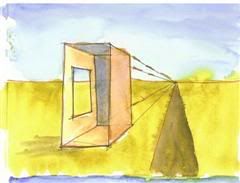

For those not familiar with those art terms, there are several ways to show depth in art. One, foreshortening, just takes the sizes and shapes of lines as though they were squashed onto a flat piece of glass. Things close are bigger, and things far away are smaller. On the other hand, there is the more geometric variety, known as perspective. Perspective is based on an eye line of the person painting the picture, which usually translates to the horizon line. Along this line are points known as vanishing points, which are the points all lines recede into the distance to meet. One Point perspective
The simplest variety is one point perspective, where there is one vanishing point, like the one in the illustration of a box with a cut out window. In this case,
all lines converge to one place, like the road and the lines of the box
and window.


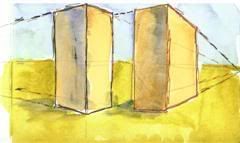
But beyond this is the idea of two point perspective, where there are two vanishing points. Two Point Perspective As can be seen by the two blocks in the illustration, this is a little more realistic in rendering, yet it is more difficult to do. In this case the vanishing point to the left is not even on the page, and trying to keep all the lines straight is not easy. But still, it looks better than the one vanishing point.


There are reasons for having three vanishing points, by the way. If we were to put a road between the two blocks in the two point picture, we might use a third vanishing point for the road to follow. Or, if we want to establish height, we might put one perpendicular to the horizon line and shrink the tops of the blocks.


When I added perspective to my paintings, the whole work look far better. The more vanishing points I add, the better it looks, though I find there are more details to consider. How much more so with Torah: every, year, when we read the same thing in the Torah at the same time of the year, we add perspectives and details to our Torah readings and study.


Note that I do not believe we change perspective, but add to our previous ones. Another change which will affect everyone who read Shlomo Drash may help here as another example. Last January, I decided that I wanted Shlomo’s Drash to be on the internet more than my little private e-mail list. So I signed up to Blogger.com, loaded one of their templates, and started blogging my columns. I then
started a website. While my enthusiasm was great at first for the website, my maintenance of it has fallen off during the last few months. As many have probably noted, the holidays section had not changed since Passover! Several projects I had hoped to keep up to date, such as Hebrew, became very difficult to do so.


Part of the problem was I used some automatic tools. For every page I created or changes, I would have to update every other page with changes. This meant that things were very difficult to manage: I even have to edit and post the website, blog, and mail list separately. The automatic tools actually requires more work than doing
the same thing manually. One reason there is no archive of Drashes on the
website is this exact problem, and trying to keep all of this stuff consistently formatted.


However, over the past several days, I learned how to do all this in code (or to use the proper vocabulary, in markup), and understand the underlying structure of a modern web page. I learned funky named markup languages like XHTML and CSS. As I learn, I can do things I could not before, and do them even faster. There will be
plenty of changes to the web site and blog, and hopefully with much better maintenance. By adding viewpoints, and learning new way to use then, the whole of the Web is far clearer to me.


What was cryptic before is no longer, and I can view the world differently because of this. Computer code is strongly literal, with only one layer of meaning. So when we look at something with multiple layers of meaning, such as Torah, how much more so can we see new things with every perspective?


Just in the earliest time of commentary, the Talmudic period, we have plenty of differing perspectives. We have Mishnah, Gemara, Midrash, and Targum, all adding differing views of the texts. Each records differing schools and differing viewpoints. We have later medieval commentators such as Rashi and the Tosafists comprised of his grandsons and their buddies. In the Sephardic world we have Ibn Ezra
and Maimonides. Of course there is the Later Hasidic movement, then Reform, Modern orthodoxy and contemporary commentary. Together they form a whole tool shed of perspective to choose from. Each is a tool to get at meaning we other wise might not decipher.


I try my best to use as many tools a possible, including my own experience in writing these columns. Yet it is all too easy to slip into a pattern of using the same few tools, to the exclusion of others. I’m not the biggest Rashi fan yet, and I’m definitely not the guy to quote Maimonides profusely. There’s a lot I could look at in Hasidic thought as well, but I have often in the last year not gone to those sources, both as a matter of availability of text and expediency of writing this column. Yet, I think it is important to look at all the texts, and not take any as a
final word on the topic. As we will see next week in only one book of midrash, Genesis Rabbah, the perspectives about what happened at the beginning of Creation are numerous. Add other aggadic works, and works from other eras, and you have a massive amount of reading to do.


But every year we need to expand. And some places are difficult to expand into if you don’t know Rabbinic Hebrew. As I learn the nuances of Rabbinic Hebrew, I’m getting closer to the time I can read many of the untranslated stuff out there, and
use those tools to understand the texts. Yet, that is still some time in the future.


Simchat Torah starts with the death of the greatest prophet of all, and ends with the beginning of everything-- all of it done in joy. I’ve had my setbacks lately in teaching Torah, many of the ways outside of the written word I wanted to are as
difficult as ever to do, and to say the least rather frustrating for me. Yet, in 5767, I’m going to be doing a lot of creating, in many different realms. To those who read this, one thing I’d like to do is give you exposure to texts you might not know existed, and give you the perspective on the texts I’ve been using for quite a while. I’m seriously looking into going from print to sound, and figuring out how to get this stuff into a podcast. But most of all, My goal in Shlomo’s Drash is not merely to get something off my chest, though often I do. It’s for everyone to learn more about being a Jew and our rich heritage of perspectives.Mine is by no means the only one, but it is the only one I can give, one which tries to make a lot of intimidating things approachable.


I hope you are as excited about engaging those new perspectives as I am as we journey together.


Hag sameach.


Thursday, October 05, 2006

Sukkot 5767 Temporary and Permanent

Sukkot 5767 - Temporary and Permanent

This week we celebrate the holiday of Sukkot. Usually there is a special Shabbat reading during Sukkot, but this year, Sukkot occurs on Shabbat. We therefore read the reading for the first day of Sukkot, which gives the mitzvah for Sukkot:
33. And the Lord spoke to Moses, saying, 34. Speak to the people of Israel, saying, The fifteenth day of this seventh month shall be the Feast of Booths for seven days to the Lord… 39. Also in the fifteenth day of the seventh month, when you have gathered in the fruit of the land, you shall keep a feast to the Lord seven days; on the first day shall be a sabbath, and on the eighth day shall be a sabbath… 41. And you shall keep it a feast to the Lord seven days in the year. It shall be a statute forever in your generations; you shall celebrate it in the seventh month. 42. You shall dwell in booths seven days; all who are Israelites born shall dwell in booths; 43. That your generations may know that I made the people of Israel to dwell in booths, when I brought them out of the land of Egypt; I am the Lord your God. [Leviticus 23]

We are told that we are to dwell in booths like the people did as they left Egypt. They are temporary homes. The halakah for Sukkot even mentions that the stars are to be seen through the roof. We have a house with an intentionally leaky roof, walls which often cannot stand a large breeze and very little temperature control. Since the first Ashkenaz Jews came north to the Rhine valley a thousand years ago, the Jewish population also has to deal with the cold weather of autumn when dwelling in their Sukkahs.

I have the most nostalgic memories of Sukkot. One of my fondest memories of childhood is building sukkahs. My family didn’t have our own sukkah, but my dad, year after year designed and put up the sukkah for the conservative synagogue we belonged to. In one of those great father and son moments, I always helped put it up. In some otherwise insane combination of lead pipe, two by fours, nails, chicken wire and corn husks, he invariably created a sukkah that could withstand the obnoxious autumn weather of Rochester, New York. I remember many a day where my religious school class would be in our winter jackets with earmuffs, gloves and hats on in that sukkah, but today I only fill the warmth that was there in its construction.

Yet as I wrote in my Sukkot commentaries in the past, one important point of the holiday is to see change. We read Ecclesiastes, which begins with an interesting Hebrew word, Hevel. Hevel means emptiness but in the way a breath is empty. One minute it’s blowing but eventually it will change. For Ecclesiastes, everything is transitory. We observe the changes in the world around us as the leaves on the trees pumpkins and gourds turn brilliantly warm colors of yellow, orange and red, in contrast to the dropping temperatures, and cold grey skies, wind and rain of October.
After the time of repentance of the Ten Days, it is time for reflection, a harvest not of crops but of our souls. Sukkot is a time to figure out what is our personal and communal harvest for the past year -- what we did right and how we changed. I started to notice many of these over the last few weeks, but it is during Sukkot I really am reflecting on this. As I said in my Rosh Hashanah drash, I learned a lot about fear over the last year, and more importantly how to get over fear, be it roller coasters or women. The fear of approaching someone I find attractive and simply saying "hello" is far less that it was this time last year. I’m even looking forward, though in an apprehensive way, to Expedition Everest, the latest thrill ride on my forthcoming trip to Disney. Yet, the sukkah itself puts fear into perspective. In a sukkah, one is at the mercy on the elements. It might rain on you. In a strong wind, it might blow down and collapse on you. Yet the temporary nature of the booth is such that it is lightweight and really wouldn’t hurt.

I also think of the changes in the thirty some odd years since those sukkahs my dad built. These days, it’s the custodial help of the synagogues who put up such things. Coming full circle, for the first time this year there is a new generation in my family going to the sukkah and decorating with popcorn chains, crayon decorations, cranberries and corn husks. Like many families I doubt my nieces and nephew will ever have memories of actually putting up the chicken wire walls of their sukkah with blue electrical wire. Even thirty years ago such things were relegated to the parking lot of the synagogue.

In the Leviticus 23 passage is an interesting irony: the most temporary of booths must be the most permanent of mitzvot with the command “It shall be a statute forever in your generations” [23:41]. In a place where we have comfortable walls only a few yards away we expose ourselves to the weather exactly when the weather starts to become uncomfortable to be outside. In a world were no one else would eat in such shanties unless they are homeless, all Jews are required to publicly show they are different than their gentile neighbors by having this not exactly beautiful booth out in their yard for the neighbors to see. If we follow the mitzvot of Sukkot, we identify ourselves as Jews. And maybe that's why there are so few suburban sukkahs -- we are ashamed of admitting our identity.

That thought came up during a yom kippur discussion about Tikkun Olam . Some people believe that charitable acts not for Jewish causes are not very Jewish. Indeed some will go as far as saying it diminishes Judaism to work alongside a secular or Christian charitable organization. Some were taken aback by one critic who claimed when it came to social justice, there was no difference between the synagogue and the local office of the ACLU.

Funny thing is, I didn’t know this person. I assume he was a member of my synagogue, but I haven’t seen him at regular Shabbat services. Synagogues are primarily prayer communities, as part of Jewish identity. Our identity is bound in the liturgy and observance. If one does not say the Barchu or Kedushah with the rest of us, is he distinguishable from any other secular American?

In Brachot 55a, we are told by the Rabbis that since the destruction of the Temple, our dining room tables are our altars, the place we eat is our holy space. In a sense the Sukkah where we are to eat two meals a day becomes a temporary holy space, one almost congruent to the Mishkan, that temporary temple in the desert and used until the time of Solomon. And it is interesting that many feel this intuitively, putting on kippot only worn in holy space in the sukkah. Abraham Joshua Heschel commented during the march at Selma he was praying with his feet. How much more so we should pray with our feet in a minyan? How much more so that we should believe every act of Tikkun Olam is done in holy space, and should be treated like a prayer space?

I believe the real issue is not about working with secular or other religions organizations; it’s that we do it in a way that is holy and congruent to Jewish practices. The traditions and kavvanah involved in any service to the greater community, needs to identify us as Jews. Even if our home practice is not strictly halakic, when working on Tikkun Olam in any form we should take on practices that identify us as Jews. If there is a shared meal while doing such community service, we don’t eat pork or shrimp or cheeseburgers. We wear kippot or head wear as if we are in synagogue or a house of study. We don’t do volunteering on Saturday mornings at the least, and preferably none at all because it is Shabbos. Gemilut Hasidim, acts of kindness does not replace Avodah (worship) and Torah (observance and study). All three are part of a three legged stool holding up the world. Like placing a sukkah in the back yard, observances in public identifies us as Jewish. And without that visual identity there is no difference between us and our neighbors. A light unto the nations cannot shine if it is hidden.

Those rickety chicken wire walls, protected only by the same gourds as Jonah’s sukkah, remind me that everyone can see into such a booth as a sukkah, and see our observance. In all my wanderings away from Judaism and back, it was the very temporary sukkah that always remained in my mind, the most permanent of the traditions I liked to follow, and regretted when I could not. I know there are many who will not place the sukkah in their back yard. Some will visit someone else’s. Some will go to that one in their synagogue parking lot that was put up by the custodial help, or even put up by a few determined members who just think it’s an important mitzvah to do. Some regardless of the weather will be eating meals in jackets and mittens and sitting on rain soaked chairs. There is always fear about what the neighbors would think, but as I learned though the last year it is like the fears of asking women for a date or riding a thrill ride at Disney World. Often, though sadly not always, that fear is misplaced. But in the end, if we do not say “I am a Jew, and that’s a good thing” both verbally and in action, we may lose being a Jew.

Quite a thing to be learned from a rickety booth.

Wednesday, September 27, 2006

Yom Kippur 5767 - What is this sin thing anyway?

As I mentioned last week, one of the major themes of Rosh Hashanah and Yom Kippur is not written in the Torah but in the Talmud, in Rosh Hashanah 16b:

R. Kruspedai said in the name of R. Johanan: Three books are opened [in heaven] on New Year, one for the thoroughly wicked, one for the thoroughly righteous, and one for the intermediate. The thoroughly righteous are forthwith inscribed definitively in the book of life. The thoroughly wicked are forthwith inscribed definitively in the book of death. The doom of the intermediate is suspended from New Year till the Day of Atonement; if they deserve well, they are inscribed in the book of life; if they do not deserve well, they are inscribed in the book of death.

Thus it is Yom Kippur that is our last chance according to this passage of Gemara. The Mishnah also mentions some of the power of the Day of Atonement

Mishnah. The sin-offering and the guilt-offering [for the] undoubted commission of certain offences procure atonement, death and the Day of Atonement procure atonement together with penitence. Penitence procures atonement for lighter transgressions: [the transgression of] positive commandments and prohibitions. In the case of severer transgressions it [penitence] suspends [the divine punishment], until the Day of Atonement comes to procure atonement. [Yoma 85b]

Yet the text goes further, saying this isn’t a free ride. The Mishnah continues:

If one says: ‘I shall sin and repent, sin and repent’, no opportunity will be given to him to repent. [If one says]: ‘I shall sin and the Day of Atonement will procure atonement for me’, the Day of Atonement procures for him no atonement. [Yoma 85b]

And the Gemara interestingly continues:

Why is it necessary to state I SHALL SIN AND I SHALL REPENT twice? — That is in accord with what R. Huna said in the name of Rab; for R. Huna said in the name of Rab: Once a man has committed a transgression once or twice, it becomes permitted to him. ‘It is permitted!? How could that come into your mind? — Rather, it appears to him like something permitted. [Yoma 87a]

This Gemara makes a very interesting statement about habit. After transgressing multiple times, the transgression becomes habit, and appears as if it is a permitted act, even when it isn’t. In my case, I am transgressing the milk and meat prohibition by having a piece of cheesecake after a grilled chicken breast. Although there is minority opinion of R. Jose the Galilean that this is permitted, for the majority it is not. For me, this prohibition has actually become practice.

In non-Orthodoxy, we find many of these types of issues. Driving on the Sabbath to synagogue would be another of such issues, or my late lighting of my Shabbat candles or a dozen other things. Many times, like my Shabbat candle practice of lighting somewhere around 10:00PM, since I’m neither home to light them earlier and too cautious of the fire hazard if I did, what is really a transgression has become spiritual practice. It thus makes it difficult to tell what really are our sins and what are not our sins given modern practices. And while it seems that Orthodoxy might have it easier here, Orthodoxy just gets more sensitive and detail oriented. It’s not the chicken and cheese that is the issue, but opening the refrigerator on Shabbat when the compressor is off -- and thus causing the thermostat to turn on, which causes a spark which is considered a prohibited fire. One can go nuts thinking about this stuff if we try to base everything on a halakaic standard, yet some try to do their best under these conditions.

Others might define sin by its human standard - that I hurt some other person, either physically or with Lashon Hara. The rabbis handle this issue too, and Yom Kippur isn’t much help here:

For transgressions as between man and the Omnipresent the Day of Atonement procures atonement, but for transgressions as between man and his fellow the Day of Atonement does not procure any atonement, until he has pacified his fellow. [Yoma 85b]

In short, the only one who can do the job in matters of people hurting people is people. One needs to get forgiveness from the person. This is also problematic for me, since many times I don’t even know I hurt someone in the first place, so I can’t even apologize. I’m sure there are times where I have inadvertently offended while giving a D’var Torah, making a speech or of course in my comments here in Shlomo’s Drash. Then there are the times where an apology may cause more harm than good -- the visual sight of the person giving the apology is enough to cause resentment and make the situation worse. There is story about a rabbi named Hanina who held a grudge against another Rabbi named Rab because he would not start a lesson from the beginning when he walked in late. As much as Rab would try to apologize on the Day of Atonement, he failed thirteen times, because R. Hanina would remember the slight and be offended again. Hanina eventually forced Rab to Leave Israel for Persia. [Yoma 87b]

In short, trying to do repentance to all this stuff is not easy, yet there is a way. We find in the Tanach a formula mentioned several times when someone is looking for forgiveness from God:

5. (K) We have sinned, and have committed iniquity, and have done wickedly and have rebelled, and have departed from your precepts and from your judgments; [Daniel 5:9]

Besides this verse from Daniel, where the confession is applied, the books of Samuel, Kings, Psalms, and Chronicles has a similar formula, asking for forgiveness of God. While not in the same order, even to those who know no Hebrew some of the words might sound familiar: Chatanu, Avinu, Hirshanu, and Maradnu. Later generations found 22 versions of sins and put them in alphabetical order to come up with the Ashamnu beginning of the public confessional, said multiple times during the Yom Kippur service. Following that is of course the 40- verse confessional Al Cheit. Both of these confessionals are rather non specific on the sins involved, keeping to the general or even outright vague.

And the key to that vagueness, and its purpose, sounds to English ears like mere poetic rhyme. Yet, it is a serious grammar point in Hebrew. In Hebrew the nu ending means we. And interestingly, the only person in Hebrew grammar which does not have a gender is the first person. ‘We’ means everyone, regardless of gender. ‘We’ is the ultimate collective, completely unjudgemental of the individual. Individuals cannot know all of their own sins that need forgiveness. But as a collective we are more likely than not to have transgressed everything. To handle the unknown sin we say together “Chatanu, we have sinned.” While some might like to think one person or another it applies to, at that point in the service we are no longer individuals, we are a congregation and such thoughts are meaningless. When we traditionally beat our heart, we beat the heart of our entire community to change and repent sixty two times.

The Netana Tokef prayer states that prayer, charity and repentance turn the stern decree. That is based on teaching found in Midrash:

R. Judan said in R. Leazar's name: Three things nullify a decree [of evil], viz. prayer, righteousness, and repentance. And the three are enumerated in one verse: If My people, upon whom My Name is called, shall humble themselves, and pray (II Chron. VII, 14)-here you have prayer; And seek My face alludes to righteousness, as you read, I shall behold Thy face in righteousness (Ps. XVII, 15); And turn from their evil ways denotes repentance; after that, Then will I forgive their sin [Genesis Rabbah XLIV:12, Kohelet Rabbah V:4, VII:21]

All three of the requirements are mentioned, but even here they are mentioned as a collective 3rd person. It is not the individual, but the group which is important. In repentance, since the goat for Azazel, this had been the case, it has not been individual repentance, but collective repentance, because in a sense we are all guilty of something, and thus in a group we repent for all of our sins. The guy standing next to me might have been the guy who did something to me, yet I am repenting for both of us. We repent not just for ourselves but our neighbors as well, for we repent for what know we did and repent for what we didn’t know.


I still don’t have a clear idea of what is and is not sin. But I do remember that we all do sin, and together we all do repent as a community on Yom Kippur. With declining attendance even at High Holiday services, that of course is becoming less the case. And maybe that is the real sin.

Thursday, September 21, 2006

Rosh Hashanah 5767 - The structure of fear

Once again Rosh Hashanah is upon us, 5767 begins, and it is time to think about our journey over the last year. One of the major themes of Rosh Hashanah and Yom Kippur is not written in the Torah but in the Talmud, in Rosh Hashanah 16b:

R. Kruspedai said in the name of R. Johanan: Three books are opened [in heaven] on New Year, one for the thoroughly wicked, one for the thoroughly righteous, and one for the intermediate. The thoroughly righteous are forthwith inscribed definitively in the book of life. The thoroughly wicked are forthwith inscribed definitively in the book of death. The doom of the intermediate is suspended from New Year till the Day of Atonement; if they deserve well, they are inscribed in the book of life; if they do not deserve well, they are inscribed in the book of death.

Yet, as I have mentioned in previous Rosh Hashanah columns, I think in terms of Aggadah. Just as we will in a few weeks begin the Story of Torah, so too do we begin the Story of our lives over again on Rosh Hashanah and Yom Kippur. I believe that this is a time of Story, we read the story of one of the most difficult decisions a father and son have to make, we read the story of a man who has a choice of saving an Enemy city or letting it fall to its destruction. Some choices are good, we read, some bad. But in all of those choices God is there with us, sometime guiding our hand subtly sometimes not.

Instead of a book of life or death I like to think that we all have our own book, the book of fully living. We either get a full chapter next year or we do not. Much of the setting and the rest of the characters come from the Scribe and Author. We are the protagonist and sometimes contributing author. We get the choices of making it a rich and vibrant colorful story full of joy and holiness and living to our best selves, or gray, drab and boring as we plod on with our lives, just waiting for the end of the book. It is traditional to say “May you be inscribed in the Good Book” at this time of year. I like to say instead “May you have another chapter in your Book of Fully Living.”

And like some old Journal, it’s a good time too look at what we did over the year. Talmud and tradition is to look at the bad things we do to turn ourselves away from them in the future, and ask forgiveness. Yet we also should look at what we did right as well, and make sure we do those too. We need to look at the whole story.

5766 was quite the year for story. I can think about it in terms of a Midrash from the book of Numbers.

And the people that dwells therein whether they are strong or weak, whether they are few or many; and what the land is that they dwell in (Num 18:18). How can you tell their strength? If they dwell in camps, they are strong, for they rely on their own strength. If they dwell in strongholds they are feeble and their hearts are timid. [Numbers R. XVI: 12]

Moses in instructing the spies what to look for and how to interpret said something rather profound. Those who are strong do not need a fortress; they have the strength to deal with the outside world. But it is the fearful who need the walls of the fortress for protection, since they really cannot defend themselves. So too with human beings. Fear is our defense, our fortification against a hostile world. Yet, like stone walls, it does other things as well. It substitutes for our own inner strength. The walls don’t just keep the bad guys out, but keeps us imprisoned within. We cannot see the good stuff out there in the world either; we stay in a siege mentality ever guarding the gates, and never growing and living.

We all have these walls and fortresses. This year however was my year for breaking down a lot of these walls. The isolation that I have suffered through had to go. A little over two years ago, on my 39th birthday, I realized that there was fear in me, and how much I was missing because of it. On a trip to Disney World, I realized that I really did fear many of the thrill rides. But in 5766, I got on many of them, whether I was afraid or not. And in almost every case, I found that it wasn’t as bad as I had expected, and indeed it was rather fun. The two water flumes and the one smaller rollercoaster I rode that trip was quite the revelation for me.

Then there was book I read on that same vacation. I’ve read it about four times now. Called The Game by Neil Strauss, it was the story of a New York Times and Rolling Stone reporter who infiltrates the world of the pick up artist. And reading this book I became fascinated by this world, not because I wanted to have a series of one night stands, but how Strauss, a geeky Jewish boy from Chicago, had some major walls protecting him, and still transformed into a pickup artist and charismatic personality. For most of the winter and spring, it was also fascinating to watch the world of shy and insecure men began to gravitate around this new guru as many in the on-line word begged and spent a ton of cash on getting all of his secrets and having his power and confidence around women. Given my own problems in getting dates, I, along with 2800 other men, even joined in Strauss' attempt to run a month long on-line workshop and get all of us date within a month.

I failed that challenge in July. Yet I failed for a rather interesting reason, one that I am rather proud of. While I learned a lot and improved many things about my self, including my grooming, confidence and dress, Strauss’ methodology was wrapped in Lashon Hara. Fundamental to the world of the pickup artist was the lie, sometime small but sometimes big. Often, it happens to merely get a laugh. The lies were to get past the defenses of the “target” the woman that a pickup artist wanted to sleep with for that night. As I wrote earlier this year, I entered this world, yet I found that it was a world too full of klippot for me. There were divine sparks there, but when the divine sparks were found, the world itself no longer held interest, it was all dark stuff. I still cannot do pickup routines, nor do I ever think I will be able to. They are also the ultimate lie, the lie to oneself. The lie that one is special and should be paid attention to because of learend scripts, not because of one’s unique Neshama. I went into this world, yet I walked out the other side a better person.

It also startled me how many would fall into this world, and how many are still very willing to do anything to get that knowledge. It also startled me how many failed, and their failure was given an interesting name: approach anxiety. Many of these men were no more than keyboard jockeys, unable to do anything but read e-books, type e-mails and e-messages on their keyboard. When it came to real action they did nothing, counter to one of the best pieces of advice I got on the art of the pickup from a rather ironic source, not The Game but the Perkei Avot:

Shammai used to say: Make your Torah established [regularity]; speak little, but do much; and receive all men with a pleasant countenance. [M. Avot 1:15]

Neither did these men they study Torah nor ethics of any other kind. All they could do was type Lashon Hara about everyone and everything. While lying made up a large part of the world of the Pickup artist the approach anxious couldn't even do that, but could only talk endlessly about what was wrong with everyone else, or gossip and slander those who were successful or succeeding.

This is not true of Just this little world of course. Anyone who has ever been on an Internet bulletin board is familiar with the type. Yet now I understand them better. I understand, since I started in the same place as them, isolated from much of the world by my own fear. They were hidden in fortresses of their own devising, with a mere archer’s window to look out into the world. The ones with approach anxiety are so scared of the real world they live behind a keyboard ever cut off from human connection, always afraid of it. Their protection is their prison. I was willing to do exercises to improve myself, such as opening conversations with five women I met at a shopping mall. Actually I did talk to a lot of people. Because of those exercises I would do, I can now do things like dance at a friend’s wedding, something that I was terrified to do only a year before. And like Shammai, I smiled at everyone. I even made it a practice to smile at a hundred people a week, until it was a habit. For me that exercise has had a benefit of a glow about me that now I notice women smile at me now even before I smile at them. My smile makes me attractive. Yet, for many, such an exercise is terrifying, as I found out when I proposed to a few of these men that they smile at ten women over the course of a week. The panic that ensued was both terrifying and quite sad to me. These poor men were totally imprisoned.

There is a wonderful story about story itself in the Talmud

R. Abbahu and R. Hiyya b. Abba once came to a place; R. Abbahu expounded Aggadah and R. Hiyya b. Abba expounded legal lore. All the people left R. Hiyya b. Abba and went to hear R. Abbahu, so that the former was upset. [R. Abbahu] said to him: ‘I will give you a parable. To what is the matter like? To two men, one of whom was selling precious stones and the other various kinds of small ware. To whom will the people hurry? Is it not to the seller of various kinds of small ware?’ [Sotah 40a]

People go the place where they get the small useful things first the luxury of gems they cannot afford tend to come second. Some went to Strauss’ story to find a way to not be lonely any more. But they are so caught in their fortress all they can do is read and complain. My adventure here is Aggadah, the small useful things, not the diamonds and rubies of the Halakah. It is a parable of isolation we have from our own fear. Too many of us live in darkness, in fortress prisons built of fear. Firing the weapons of Lashon Hara, both men and women combat each other from these fortresses, never getting together, always being alone, and somehow believing this safer. Breaking down the barriers brings light, and love and joy into an otherwise dark world. Torah repeatedly teaches us that the only fear we should have is the fear of HASHEM, which is far different in character than the fear of anything in this world. Fear in this word is the beginning of isolation, but as Proverbs states “the fear of HASHEM is the beginning of wisdom” (Prv. 9:10) and of wisdom it is written:

13. Happy is the man who finds wisdom, and the man who gets understanding. 14. For the merchandise of it is better than the merchandise of silver, and its gain than fine gold. 15. (K) She is more precious than rubies; and all the things you can desire are not to be compared to her. 16. Length of days is in her right hand; and in her left hand riches and honor. 17. Her ways are ways of pleasantness, and all her paths are peace. 18. She is a tree of life to those who lay hold on her; and happy is every one who holds her fast. (Proverbs 3:13-18)

During Rosh Hashanah we make the fear of God a little more real with the metaphor of the Books of life and death. That fear of God however is for us to search our own stories of the year past, to see where we went wrong and where we went right. It is for us to break down the bricks of our isolation through telling our stories, to exchange the small ware of our lives with others. When we do, we find strength, and there is another chapter in our book of fully living.

So may you have a wonderful and awesome chapter in your book of fully living in the next year.

Thursday, September 14, 2006

Parshat Nitzavim-Vayeilech 5766: Back to School

Deuteronomy 29:9- 31:30

This week we continue the address of Moses to the congregation. During this he notes:

Surely, this Instruction which I enjoin upon you this day is not too baffling for you, nor is it beyond reach. It is not in the heavens, that you should say, "Who among us can go up to the heavens and get it for us and impart it to us, that we may observe it?" Neither is it beyond the sea, that you should say, "Who among us can cross to the other side of the sea and get it for us and impart it to us, that we may observe it?" No, the thing is very close to you, in your mouth and in your mind, to observe it. [Deut 30:11-14]

There are many interesting midrashim about this passage. The rabbis open up one such midrash with a verse from Proverbs:

Wisdom is as unattainable to a fool as corals; he opens not his mouth in the gate (Prov. XXIV, 7). What is the meaning of,’ Wisdom is as unattainable to a fool as corals’? R. Tanhuma said: The fool enters a synagogue and sees people there engaged in discussing the law, and as he knows not what they are saying he feels ashamed…

The Rabbis say: The fool enters the synagogue, and seeing there people occupying themselves with the law he asks: 'How does a man begin to learn the law?’ They answer him: ‘First a man reads from a Scroll, then the Book [of the law], and then the prophets, and then the Hagiographa; when he has completed the study of the Scriptures he learns the Talmud, and then the Halakah, and then the Aggadah.’ After hearing all this [the fool] says to himself, ‘When can I learn all this?’ and he turns back from the gate. This is the force of, ’He opens not his mouth in the gate.’ [Deut R VIII]

If this didn’t make any sense, R. Jannai gives a parable.

R. Jannai said: This can be compared to a loaf suspended in the air; the fool says, ‘Who can bring it down?’ But the wise man says, ‘Did not someone suspend it? ‘And he takes a ladder or a stick and brings it down. So anyone who is a fool says: ‘When will I succeed in reading the whole law? ' But the man who is wise-what does he do? He learns one chapter every day until he completes the whole law. God said: ' IT IS NOT TOO HARD, but if [you find it] too hard, it is your own fault, because you do not study it.’

This all comes to mind because it is Elul and September. This is back to school time once again. My first day of Hebrew studies for the academic year is this week, and many school children once again take up the aleph bet and the rest. But for many in their later years there is a resistance to learning. Apparently this was a problem in the time of the rabbis as much as today for them to write these midrash. The rabbis knew the study of Torah was an endless task. There are so many levels involved that it is not a task that anyone can do instantly, nor can it ever be completed in a life time. The fool of these stories sees study and has a reaction of not studying. The fool is intimidated and ashamed he is not among this number of scholars. In his shame he turns for the door since he feels he does not belong there. In the second case he sees the end product, knows the process, but thinks he does not have time to do the work.

Yet there is a wonderful story found in another midrash to remind us it is never too late to learn:


What were Akiva's beginnings?
It is said: Up to the age of forty, he had not yet studied a thing. One time, while standing by the mouth of a well in Lydda, he inquired, "Who hollowed out this stone?" and was told, "Akiva, haven't you read [in Scripture] that 'water wears away stone' [Job 14:19]?--it was water [from the well] falling upon it constantly, day after day. "At that, R. Akiva asked himself: Is my mind harder than this stone? I will go and study at least one section of Torah. He went directly to a schoolhouse, and he and his son began reading from a child's tablet. R. Akiva took hold of one end of the tablet, and his son of the other end. The teacher wrote down alef and bet for him, and he learned them; alef to tav, and he learned them; the book of Leviticus, and he learned it. He went on studying until he learned the whole Torah. [Avot R. Natan 6]

This story of R. Akiba’s education, who would become one of the greatest scholars of all time, started strangely enough in mid-life observing a stone, hollowed away by drops of water. He took that a a model for learning, taking everything in drop by drop. We read elsewhere he took a total of twenty four years of study to achieve his scholarly greatness. [b. Ketubot 62-63a]

Jewish practice is based on divine revelation of mitzvot happening very rarely, if not only once at Sinai. Judaism is not a religion which believes that people can change the rules on their own by talking to God. Moses in his speech is reminding the people that from now on there is no divine revelation of law, there is only the judgment of a majority. With the death of Moses, there will be no more like Moses, in that there will be no more telling us laws and practices. Granted the prophets tell us that we’re doing those practices wrong, but in very rare emergencies does anyone create a new law. It’s all there in Torah.

Our verse is even quoted by the rabbis in the famous case of Baba Metzia 59b. In the story, rabbi Eliezer Calls on a Divine voice, a bat kol, to prove his legal point. When the voice from heaven agrees with R. Eliezer, R. Joshua objects, quoting “it is not in heaven!” God’s reaction to this, it is claimed, was laughing in joy repeatedly saying “my sons have defeated me!” Whether this really happened or was propaganda for strengthening the rabbinic authority, it does reflect a major theme of Judaism, the core of our passage in Deuteronomy. We are a religion where God’s commandments to us are as close as our mouths and our minds - the discourse of the house of study.

The Torah is as close as education. Education is to say the least not easy and does take a lot of time. In my fourth year of grad school and my ninth year of studying Hebrew, I realize how much more I have to go. Akiba learned his aleph-bet and even Leviticus rather fast, yet even he took twenty-four years to study enough to be the scholar we celebrate today. And while he had an incredible mind for halakic works, apparently many rabbis thought him inferior in some other areas of study. Even the great R. Akiba was uneven in his studies.

The point of education is not that it is done and gotten over. It is a process of learning, and there is always more to learn, drop by drop. I might eventually learn this Rabbinic Hebrew I’m struggling with now. But learning it is only a step into a bigger world of actually delving into the material of the rabbis, be it Midrash Rabbah or the lesser know ARN or Sifrei. There’s always more to study and learn. And while we are learning, we still transmit it to others, spreading the knowledge of mitzvot tradition and story of the Jewish people.

Jewish education is really never far. All it really needs is a book like Torah or Mishnah and a few people talking and thinking about the divine words on the page. While not believing in divine revelation of mitzvot any more the Talmudic Rabbis did equate conversation of Torah with divine revelation in the Perkei Avot:


If three have eaten at one table, and have spoken thereat words of Torah, [it is] as if they had eaten at the table of the All-present, Blessed be He [M. Avot 3:3]

[When there are] ten sitting together and occupying themselves with Torah, the Shechinah abides among them, as it is said: God stands in the congregation of God. [M. Avot 3:6]

As Elul ends and we get ready for the new year of 5766, whether you study every day or not at all, everyone should consider as a new years resolution adding a little more Study to their lives. Every time I walk into the classroom, I am always awed by the students and teachers around me and our divine conversation. Whether it is a grammatical point or a discussion of the legitimacy of the death penalty, the Shechinah resides among us every Wednesday night. I remember that a decade ago I knew nothing. And like Akiba before he studied, I was even hostile to scholars. Yet later in life I, like Akiba, am learning and working towards being one of those same scholars. I’m still growing, taking things step by step, not ashamed about where I am still ignorant, nor would I ever consider I’ll quit because I don’t have the time to study.

It is easy to be the lazy fool or the ashamed fool, But it is such a joy to have the Shechinah as a guest at your table. May you have the privilege of her sitting at your tables too.